Who Doesn’t Love a Bit of Workplace Drama?

(and why it’s actually exhausting you)
Let’s be honest, workplace drama can be weirdly entertaining. The eye-rolls in the team chat, the “you won’t believe what they said” debriefs, the meeting where everyone’s talking but no one’s really listening. It feels like a soap opera you can’t look away from.
For about five minutes.
Then it stops being funny. You leave that meeting drained. You avoid that colleague. You spend more energy navigating personalities than actually doing your job. You spend even more time outside of work talking about it. That “bit of drama” turns from entertainment to annoying to being toxic. And it’s burning your team out.
Where does this drama come from?
Often, it starts with the typical stressors and triggers: tight deadlines, unclear roles, pressure from above, or just friction between strong personalities. But what escalates these triggers into exhausting workplace drama are the roles we fall into when things get tense.
That’s where The Drama Triangle comes in.
Developed by Stephen Karpman (1968) as a way of graphically displaying the complex interaction that occurs between people caught in conflict. Karpman observed that in conflict and drama, there is ‘good guy vs bad guy’ thinking. He also observed that the participants become drawn in, even seduced by the energy that the drama generates (sound familiar?). The drama obscures the real issues. Confusion and upset escalates. Solutions are no longer the focus. Essentially, drama takes over and it starts having a negative impact on our health and well-being.
What does this triangle look like and what are the three roles we all play (without realising it):
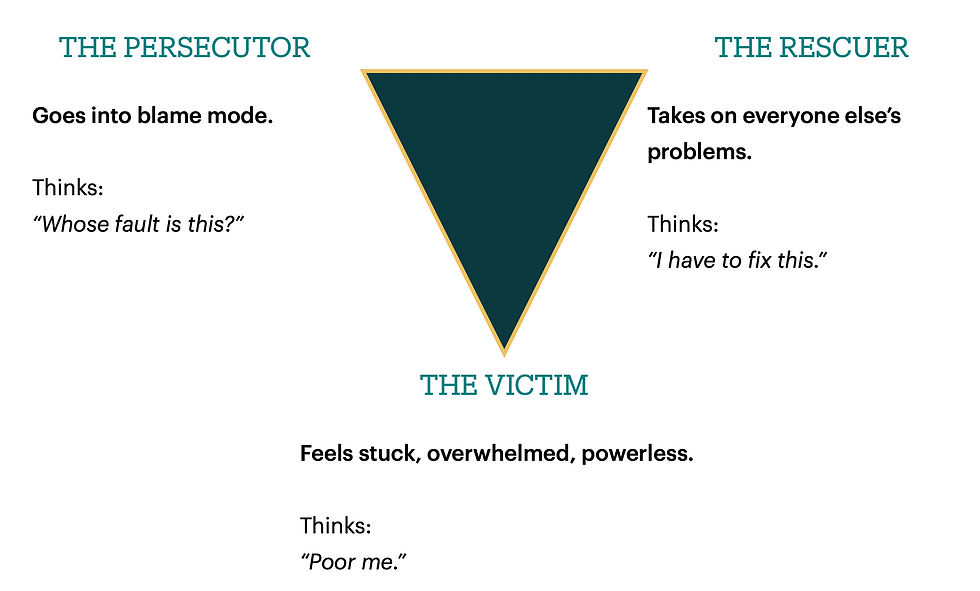
We've all been in one of these roles, maybe all three in the same week! It’s not because we’re bad at our jobs it’s because we’re human. But this triangle keeps us running in circles. It burns trust, kills productivity, and makes work feel heavy.
You’re probably thinking: “Okay, but what does this look like on a Tuesday at 3 PM?” Let’s take a real example.
To set the scene: The quarterly report is late (eek)
The Persecutor mode, for example, your manager says, “Whose fault is this? This should have been done last week.”
The Victim mode responds with a team member thinking/saying, “I can’t do anything right. Nothing I do matters.”
In comes the Rescuer mode, the superhero (or so they think) jumps in and says, “Don’t worry, I’ll stay late and finish it!”
The toxic part or the ‘no-win’ outcome:
The Persecutor doesn’t learn that their response is damaging because the Rescuer comes in to save the day.
The Rescuer burns out from the additional workload and quietly builds resentment for always “saving” everyone.
The Victim remains a victim because they’re left with their negative self-talk that “nothing they do matters”
Everybody loses.
So what are we going to do?
In comes Acey Choy (1990) with the antithesis (the antidote) of The Drama Triangle, Choy introduces The Winners Triangle.

This is about shifting our Drama Triangle roles to the Winners Triangle roles. We can’t “stop” the pattern but we can choose a different role.
Shifting from Persecutor to Challenger: Give up trying to force or manipulate others to do what you want. Take on the new behaviours of ‘doing’ and ‘asserting’. Ask for what you want. Say no for what you don't want. Give constructive feedback. Initiate negotiations. Take positive action.
Shifting from Victim to Creator: Accept the situation you are in and take responsibility to problem solve and function in a more healthy and happy way. Put real thought into what you want and how to get it, and take action to make it happen.
Shifting from Rescuer to Coach: Simply be supportive, listen and provide reflection, coaching, and assistance if the person asks and is taking the lead themselves.
Let’s replay that scene: the quarterly report is still late. But this time, let’s shift the roles.
The Challenger (formerly the Persecutor) manager says
“Okay, the report’s late. What’s getting in the way? What do you need from me to get this back on track?”
The Creator (formerly the Victim) team member contributes with
“I can take the data section, I’ll have it done by 4 PM. Who can handle the executive summary?”
And the Coach (formerly the Rescuer) steps in and says
“Let’s break this down. How can we split the work so nobody’s here till midnight?”
The now ‘win-win’ outcome:
The Challenger addresses the problem without blame, opening up solutions instead of shutting people down.
The Creator moves from “I can’t” to “I can influence this part,” rebuilding a sense of agency.
The Coach supports without taking over, preventing burnout and building collective accountability.
The report still gets done. But this time, trust stays intact. Energy is preserved. And people leave feeling capable, not crushed.
That’s the shift. It’s not about eliminating pressure because deadlines and reports will always be there. It’s about changing the dynamic under pressure. And that’s a skill any team can learn.
Why learn it? Because workplace drama isn’t just a “people problem.” It’s a performance problem. Teams stuck in these roles experience higher burnout, more conflict, and lower engagement. They also lose good people because talented employees don’t leave companies, they leave toxic dynamics.
What can you do?
Next time you feel that familiar tension rising in a meeting, a difficult conversation, or even in your own head, pause and ask yourself:
“Which role am I in right now? What would a more helpful role look like?”
That’s it, you just need to notice the pattern.
Want to dive deeper? At CMWC, I help teams and leaders repair the broken conversations that drain energy and push talent out. I focus on practical tools like this one because change doesn’t have to be a big, scary overhaul. It can start with one conversation.
Work shouldn’t drain your energy. It should be civil, clear, and human. And change is always possible, it might not be easy, it might not be straightforward, but it is possible. Sometimes it just starts with naming the pattern.


Comments